
Round Flange Immersion Heater Suppliers in India: Complete Selection Guide
Round Flange Immersion Heater Suppliers in India: Complete Selection Guide
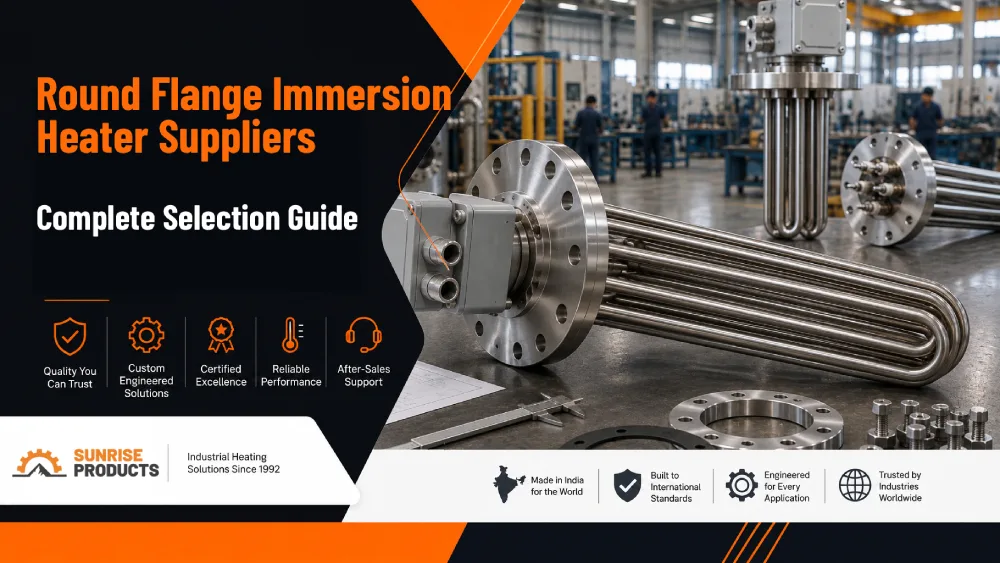
A round flange immersion heater bolts onto a tank flange and heats liquid directly from inside. Multiple hairpin tubular elements mount on a circular flange plate, giving high power in a compact footprint for water, oil, chemicals, and process fluids.
This guide explains design basics, sizing inputs, material selection, controls, and how to evaluate round flange immersion heater suppliers in India.
Design Features
A typical assembly includes:
- Hairpin tubular elements arranged in a circular pattern on the flange
- Flange plate: standard ANSI sizes from 3 inch to 14 inch, in carbon steel or stainless steel
- Terminal housing: NEMA-rated enclosure for electrical connections
- Thermowell: port for temperature sensor insertion
- Sheath options: SS-304, SS-316, Incoloy, titanium, or PTFE-coated types based on fluid chemistry
For radiant process heating, see our infrared quartz heating element supplier guide. For surface heating, see industrial strip heaters suppliers in India.
Sheath Selection by Fluid
| Fluid Type | Sheath Material | Typical Industries |
|---|---|---|
| Water, mild solutions | SS-304 | HVAC, boiler feed, general manufacturing |
| Chemical solutions, mild acids | SS-316 | Chemical processing, pharma |
| Oils, hydrocarbons | Carbon steel, SS-304 | Petrochemical, lubricants |
| Seawater, brine | Titanium | Desalination, marine, food processing |
| Strong or corrosive acids | PTFE-coated, Incoloy | Semiconductor, metal finishing |
If your supplier recommends a sheath without asking for fluid details, treat that as a warning sign. Corrosion matching needs actual process data.
Sizing Inputs Your Supplier Needs
Share these seven inputs for an accurate quotation:
- Tank dimensions and volume including length, diameter, and capacity
- Fluid type and heat capacity such as water, oil, chemical mix, or viscous fluid
- Start and target temperatures at your site conditions
- Heating time within which the target must be reached
- Operating pressure for flange rating and gasket choice
- Power supply including voltage, phase, and available amperage
- Tank material to avoid galvanic corrosion with the sheath
Good suppliers will run thermal calculations and state the assumed watt density in the quotation. Typical bands are about 20 to 50 W per sq inch for water, 15 to 30 for oil, and 5 to 15 for viscous fluids.
Process Control Integration
A complete installation needs more than the heater:
- Temperature sensor: RTD PT100 or Type J/K thermocouple in the thermowell
- PID controller: digital control with setpoints and alarms
- High-limit cutoff: backup protection if the main controller fails
- Low-level cutoff: stops dry firing when tank level drops
Confirm control compatibility with your supplier before ordering, especially sensor type and thermowell size.
Supplier Evaluation Checklist
- Can they perform thermal calculations for your tank duty?
- Do they offer multiple sheath alloys including SS-316 and titanium?
- Do they provide ANSI flange options with correct pressure ratings?
- Do they test hi-pot strength, insulation resistance, and wattage?
- Can they supply thermowell, sensors, and control guidance?
- Is there ISO 9001 certification with stage-wise inspection?
- Are warranty terms (12 months minimum) clearly stated?
- Can they share references from your industry vertical?
Common Buying Mistakes
- Oversized watt density: scorches fluids and shortens element life
- Wrong sheath alloy: the most expensive failure mode in immersion heating
- No level protection: a single dry run can destroy the bundle
- Ignoring controls: a heater without proper control hunts, overshoots, and wastes energy
Why Source from Sunrise Products?
Sunrise Products builds round flange immersion heaters with ANSI-standard flanges, SS-304, SS-316, and special-alloy elements, plus terminal enclosures and thermowell options. With over 20 years of manufacturing experience and in-house testing, we size watt density to your fluid and duty before we build.
See our round flange immersion heaters or browse the full product range. To discuss your tank duty, contact our team.
Call us: +91-9811017492
Frequently Asked Questions
Q: How do I prevent corrosion in round flange immersion heaters?
Match sheath material to fluid chemistry. SS-316 suits mild acids, titanium resists chlorides and seawater, and Incoloy suits high-temperature oxidation duty. Share your fluid analysis with the supplier and get the recommendation in writing.
Q: What inputs does a supplier need to size my heater?
Tank size and volume, fluid type, start and target temperatures, heating time, operating pressure, available voltage and phase, and tank material. With these inputs a good supplier will run thermal calculations and suggest watt density.
Q: What watt density suits water and oil heating?
Typical practice is about 20 to 50 W per sq inch for water, 15 to 30 for oil, and 5 to 15 for viscous or heat-sensitive fluids. Final values depend on flow, controls, and sheath limits.
Q: Do I need process control with the heater?
Yes. Plan for a temperature sensor in the thermowell, a PID controller, a high-limit safety cutoff, and a low-level cutoff so the heater never runs dry. These controls protect both product and element life.
Q: What is the typical lead time for custom flange immersion heaters?
Standard units usually ship in 1 to 2 weeks. Custom flange sizes and special-alloy elements usually need 4 to 6 weeks for design, material purchase, build, and testing.