
Infrared Quartz Heating Element, Strip Heaters & Round Flange Immersion Heater: Complete Supplier Guide
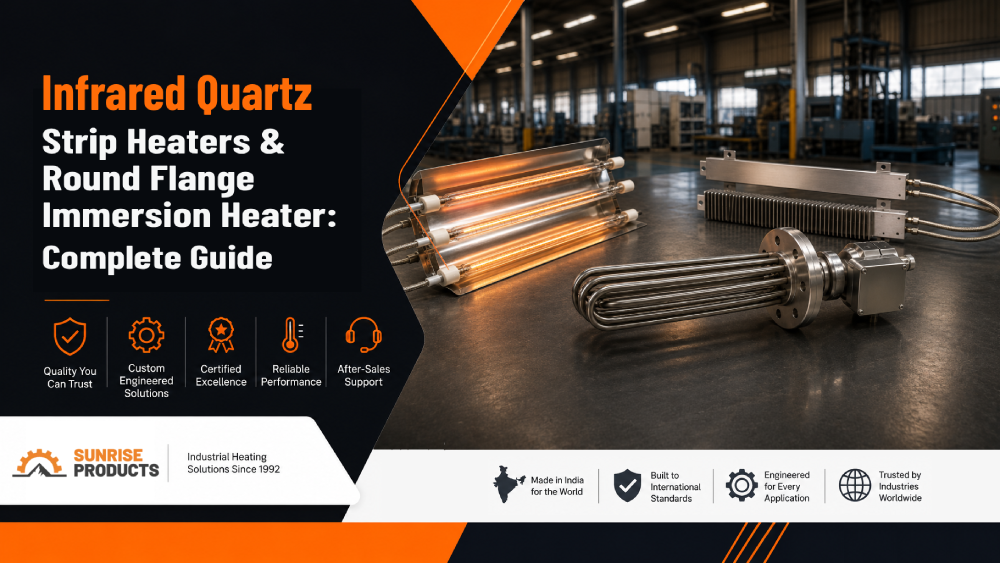
Infrared Quartz Heating Element, Strip Heaters & Round Flange Immersion Heater: Complete Supplier Guide
Industrial heating spans a wide range of technologies, each suited to specific processes and materials. Three product categories that consistently appear in procurement specifications across manufacturing sectors are infrared quartz heating elements, industrial strip heaters, and round flange immersion heaters. Despite their different operating principles, they share a common requirement: sourcing from reliable industrial strip heaters suppliers India and specialized manufacturers who understand both the technology and the application.
This guide covers how each product works, where it’s used, and what to look for when evaluating suppliers.
Infrared Quartz Heating Elements: Technology and Applications
An infrared quartz heating element uses a quartz tube housing that encases a tungsten or nichrome filament. When electrical current passes through the filament, it generates medium to short-wave infrared radiation — heat that transfers directly to the target material without needing to heat the surrounding air first.
This direct radiative transfer makes infrared quartz heating element technology exceptionally efficient for applications where fast heat-up, precise temperature control, and clean heating are essential.
Key Advantages
- Rapid response time: Reaches operating temperature in seconds, not minutes
- Directional heating: Infrared radiation can be focused on specific zones using reflectors
- Energy efficiency: No energy wasted heating air — heat transfers directly to the workpiece
- Clean operation: No combustion byproducts, no air turbulence that could disturb coatings or powders
- Long service life: Quartz tubes withstand thermal shock better than ceramic alternatives
Primary Applications
| Industry | Application |
|---|---|
| Printing & Packaging | Ink drying, adhesive curing, shrink wrapping |
| Textiles | Fabric drying, heat setting, lamination |
| Automotive | Paint curing, plastic thermoforming |
| Food Processing | Sterilization, drying, baking |
| Plastics | Preheating, stress relieving, welding |
| Glass & Ceramics | Annealing, tempering, drying coatings |
When sourcing an infrared quartz heating element supplier, verify that the manufacturer can specify wavelength output (short, medium, or long wave), as different materials absorb infrared at different wavelengths. A supplier who can’t answer wavelength questions probably lacks the depth you need.
Explore our infrared quartz heating elements
Industrial Strip Heaters: Versatile Surface Heating
Industrial strip heaters are flat, rectangular heating elements designed for direct surface mounting. They provide uniform heat across their contact area and are among the most versatile heating solutions in industrial settings.
Construction and Materials
A typical industrial strip heater consists of:
- Resistance wire (NiCr 80/20 or Kanthal FeCrAl for high-temperature applications)
- Mica or ceramic insulation: Mica for temperatures up to 480°C; ceramic for higher-temperature applications
- Stainless steel sheath: SS-304 or SS-316 for corrosion resistance
- Mounting hardware: Bolts, clamps, or spring-loaded brackets for secure surface contact
Where Strip Heaters Are Used
Industrial strip heaters find applications wherever flat surfaces need heating:
| Application | Description |
|---|---|
| Die and mold heating | Maintain consistent tool temperature in injection molding and die-casting |
| Food warming | Surface heating for warmers, holding cabinets, and serving counters |
| Tank and hopper heating | External surface heating of material hoppers to prevent material bridging |
| Oven heating | Supplemental or primary heat sources in industrial batch ovens |
| Anti-condensation | Prevention of moisture formation on electrical enclosures and control panels |
| Air heating | Mounted inside ducts or plenums for forced-air heating systems |
Finned vs. Non-Finned Strip Heaters
When evaluating industrial strip heaters suppliers India, you’ll encounter two main configurations:
- Standard strip heaters: Direct surface contact; ideal for conductive heat transfer
- Finned strip heaters: Aluminum fins attached to the sheath increase surface area by 5–10×; optimized for convective air heating
For applications requiring heat transfer to moving air, finned strip heaters deliver significantly higher efficiency despite the marginal cost increase. If your industrial strip heaters suppliers India don’t offer finned variants, they may not have the full engineering capability you need.
Round Flange Immersion Heaters: Tank and Vessel Heating
Round flange immersion heaters are designed for direct immersion into liquids stored in tanks, vessels, and process equipment. The “round flange” refers to the circular mounting plate that bolts onto a tank flange opening, creating a sealed, secure installation.
Design Features
A round flange immersion heater assembly typically includes:
- Multiple hairpin tubular heating elements arranged in a circular pattern on the flange
- Flange plate: Standard ANSI sizes (3-inch to 14-inch) in carbon steel or stainless steel
- Terminal housing: NEMA-rated enclosure protecting electrical connections
- Thermowell: Integrated temperature sensor port for process control
- Material options: SS-304, SS-316, Incoloy 800/825, titanium, or Hastelloy depending on fluid chemistry
Application Scenarios
| Fluid Type | Sheath Material | Typical Industries |
|---|---|---|
| Water, mild solutions | SS-304 | HVAC, boiler feed, general manufacturing |
| Chemical solutions, acids | SS-316, Hastelloy | Chemical processing, pharmaceuticals |
| Oils, hydrocarbons | Carbon steel, SS-304 | Petrochemical, lubricant manufacturing |
| Seawater, brine | Titanium | Desalination, marine, food processing |
| Corrosive acids | PTFE-coated, Incoloy | Semiconductor, metal finishing |
Sizing Considerations
When specifying a round flange immersion heater, suppliers need:
- Tank dimensions and volume — length, width/diameter, and total capacity
- Fluid type and specific heat capacity — water, oil, chemical solution, or viscous material
- Target temperature and ambient start temperature — determines total heat load
- Heating time requirement — how quickly the fluid must reach the target temperature
- Operating pressure — influences flange rating and gasket selection
- Available electrical supply — voltage, phase, and available amperage at the installation site
- Tank material and any chemical compatibility constraints — prevents galvanic corrosion between the heater sheath and the tank
Reputable round flange immersion heater suppliers will perform thermal calculations and recommend the optimal watt density — typically 20–50 W/in² for water, 15–30 W/in² for oil, and 5–15 W/in² for viscous or temperature-sensitive fluids.
Process Control Integration
Beyond the heater itself, proper temperature control is essential for safe and efficient operation. A complete round flange immersion heater installation should include:
- Temperature sensors: RTD (PT100) or thermocouple (Type J/K) mounted in the thermowell for accurate process temperature feedback
- Digital temperature controller: PID-based controllers provide precise temperature regulation with programmable setpoints and alarms
- High-limit safety cutoff: A redundant over-temperature protection device that shuts down the heater if the primary controller fails
- Liquid level switch: Low-level cutoff prevents the heater from operating if the tank runs dry, which would cause immediate element burnout
See our round flange immersion heaters
The India Manufacturing Advantage
India has emerged as a competitive source for these specialized heating products for several reasons:
- Manufacturing depth: Indian industrial strip heaters suppliers and immersion heater manufacturers have decades of experience supporting domestic industries
- Export quality: Many Indian manufacturers already supply European and North American OEMs, indicating global quality parity
- Engineering flexibility: Indian suppliers typically accept smaller minimum order quantities and accommodate customization requests that larger Western manufacturers might decline
- Documentation support: Experienced suppliers provide material certificates, test reports, and compliance documentation for export clearance
Supplier Evaluation Framework
Whether you’re sourcing an infrared quartz heating element supplier or industrial strip heaters suppliers India, apply this evaluation checklist:
Technical Capability
- Can the supplier specify wavelength output for infrared elements?
- Do they offer both mica and ceramic strip heater variants?
- Can they perform thermal calculations for flange immersion heater sizing?
- Do they have in-house testing for hi-pot, insulation resistance, and wattage verification?
- Can they provide material certificates (MTC) for sheath alloys and resistance wire?
Manufacturing Quality
- ISO 9001 certification
- Documented quality control process with stage-wise inspection
- Environmental testing capability (thermal cycling, corrosion resistance)
- Calibrated measurement equipment with traceable standards
Business Reliability
- Export track record to your target region
- Client references from your industry vertical
- Clear warranty terms (minimum 12 months)
- Responsive pre-sales communication — slow responses here predict slow responses later
- Transparent pricing with detailed quotation breakdown
Why Source from Sunrise Products?
Sunrise Products manufactures all three product categories covered in this guide:
- Infrared quartz heating elements: Short-wave and medium-wave options with custom wavelengths, dimensions, and reflector configurations
- Industrial strip heaters: Standard and finned variants in mica-insulated and ceramic-insulated designs, custom sizes and wattages
- Round flange immersion heaters: ANSI-standard flanges with SS-304, SS-316, or special-alloy elements, complete with terminal enclosures and thermowell options
With over 20 years of manufacturing experience, in-house testing facilities, and a track record of supplying clients across India and export markets, we offer the technical depth that demanding industrial applications require.
Explore our full product range or contact our engineering team to discuss your specific requirements.
📞 Call us: +91-9811017492
Frequently Asked Questions
Q: What wavelength should my infrared quartz heating element operate at?
Short-wave (0.78–1.4 μm) penetrates deeper and works well for water-based coatings and plastics. Medium-wave (1.4–3.0 μm) is better for paints, powders, and most industrial drying. Your infrared quartz heating element supplier should help you select based on the material being heated.
Q: Can industrial strip heaters be used outdoors?
Standard strip heaters are designed for indoor use. For outdoor or washdown environments, specify moisture-resistant terminal housings (NEMA 4X) and stainless steel construction. Discuss environmental conditions with your industrial strip heaters suppliers India before placing an order.
Q: What is the maximum temperature for mica-insulated strip heaters?
Mica-insulated strip heaters typically operate up to 480°C (900°F). For higher temperatures, ceramic-insulated strip heaters can reach 760°C (1400°F), though watt density must be reduced accordingly.
Q: How do I prevent corrosion in round flange immersion heaters?
Select the appropriate sheath material based on your fluid chemistry. SS-316 handles mild acids; titanium resists chlorides and seawater; Incoloy withstands high-temperature oxidation. Reputable round flange immersion heater suppliers will recommend materials based on your specific process fluid analysis.
Q: Can I get custom-sized infrared quartz heating elements?
Yes. Most infrared quartz heating element manufacturers offer custom lengths, diameters, wattages, and terminal configurations. Provide your dimensional constraints and power requirements for a custom quotation.
Q: What is the typical lead time for custom industrial heaters?
Standard catalog items typically ship within 1–2 weeks. Custom-engineered heaters — especially round flange immersion heaters with special-alloy elements — require 4–6 weeks for design, material procurement, manufacturing, and testing.